Making Music With Tetraplegia: How JOHKES Records and Mixes at Home
The short version
JOHKES is a UK rapper with tetraplegia who records, produces and mixes his own vocals in Logic Pro, with his left hand. He explains how he records around his breathing, the vocal chain he built for the voice he has now, and why a volume knob can be harder than automation.
On this page
- How did he get back to music after the accident?
- What does his home studio look like?
- How do you use Logic Pro with one hand?
- How do you record vocals with limited breath control?
- How has his voice changed?
- How do you mix your own vocals when your voice has changed?
- What still gets in the way?
- What would he tell other disabled musicians?
- Key takeaways
- About JOHKES
JOHKES records, produces and mixes his own music at home, in Logic Pro, with his left hand. Some days the hardest part of a session isn’t the automation or the vocal take. It’s a volume knob at the back of the desk.
He is an independent rapper and songwriter from Leicester, now based in Lincoln. A road accident in 2023 left him in a three-week coma and with tetraplegia, which changed his breathing, his voice and the hand he works with. His album Peace I Can’t Wake To came out on 24 September 2026.
Tetraplegia (also called quadriplegia) is paralysis from an injury to the spinal cord in the neck. It affects all four limbs to some degree, and how much varies a great deal from one person to the next.
We asked him how he works now: the setup, the takes, the mix and the things that still get in the way. The questions are ours; the answers are his, printed as he wrote them.
How did he get back to music after the accident?
He started writing again in hospital, on his phone, long before he could get back into a studio.
I started writing music again while I was still in hospital. About three weeks after waking up from my three-week coma, I had my phone back and started writing songs in the Notes app.
The hardest thing was realising I didn’t have the breath control I used to have. Rapping suddenly became much harder. I also couldn’t physically set up my own studio anymore, which was a difficult adjustment.
What does his home studio look like?
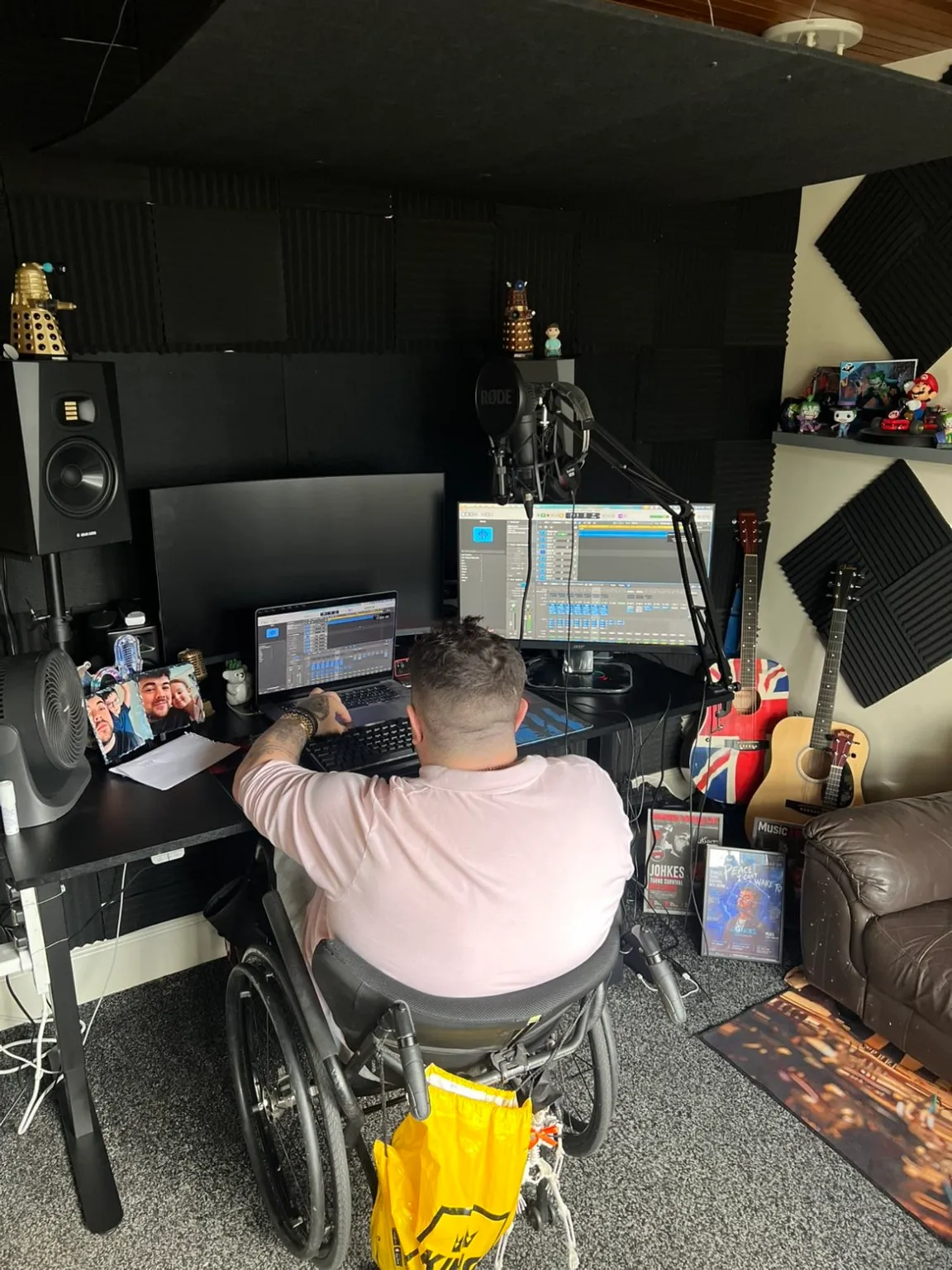
Much like anyone else’s. The difference is that someone else has to put it together, and once it’s in place, everything has to sit where he can use it on his own.
My setup includes a Rode NT1-A microphone, a Focusrite audio interface, ADAM Audio studio monitors and Beats headphones. I use Logic Pro for recording, production and mixing.
My microphone is on a swing arm, so I can pull it down when I’m ready to record. I position the microphone, set my levels and handle the recording and mixing independently. Although I can’t assemble the whole studio myself anymore, once everything is in place I can get on with making music.
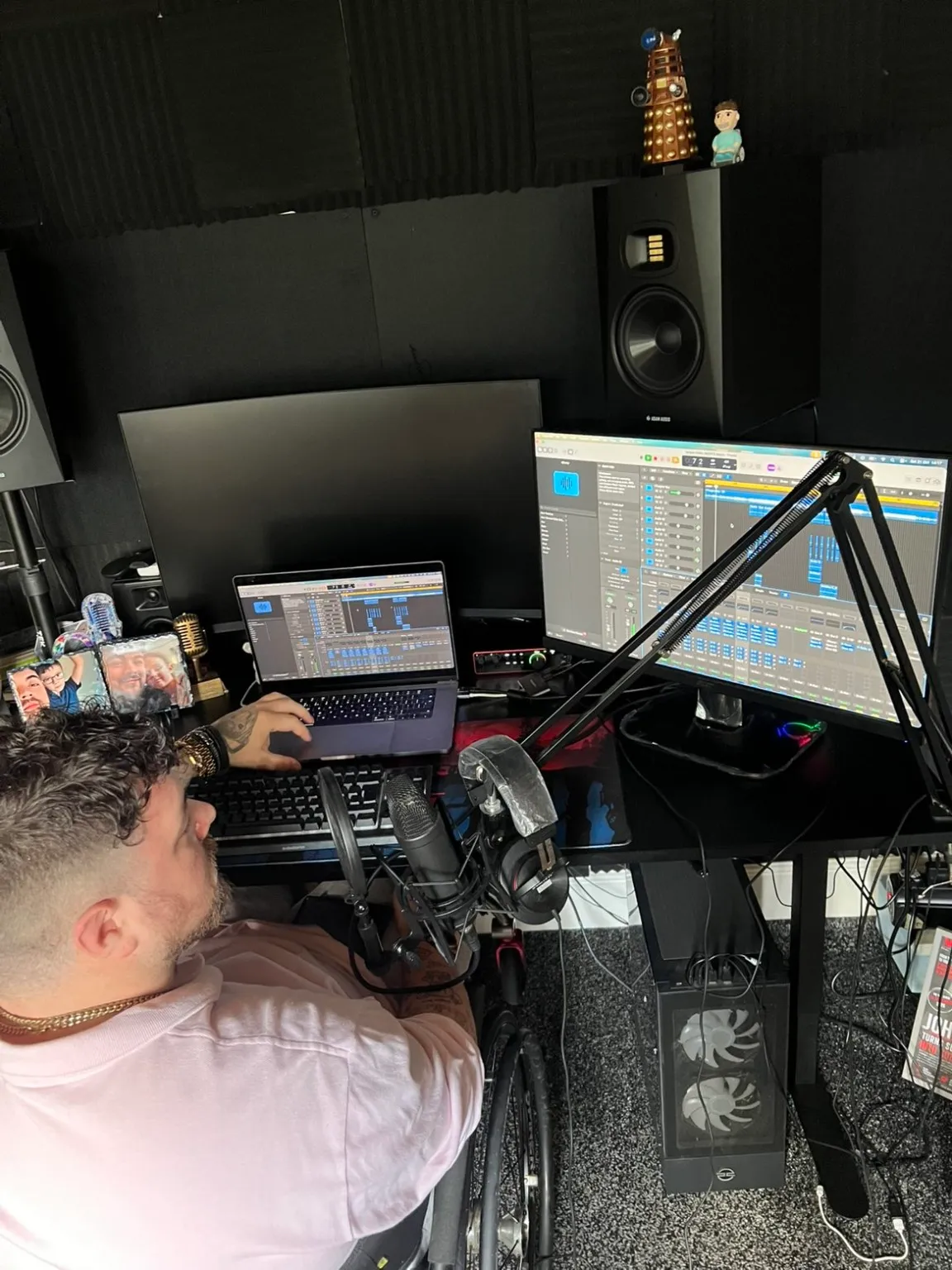
The microphone lives on a swing arm, so he can pull it down in front of him when he’s ready to record.
How do you use Logic Pro with one hand?
The same way anyone else does, only with his non-dominant hand. The tiny controls are the hard part.
I use Logic pretty much the same way anyone else would, except I do everything with my left hand. I was right-handed before my accident, but my right hand is impaired because of the injury. I’ve had to get used to using my non-dominant hand.
I have a height-adjustable desk so my wheelchair fits underneath. The most frustrating bits are the tiny controls, particularly automation. Trying to make precise adjustments with my left hand can drive me mad, but I still do it myself — even if my computer hears some colourful language along the way!
How do you record vocals with limited breath control?
In breath-sized sections. He records until he feels his breath running out, notes where that happens, keeps the take and picks up from there.
Because my breath control has changed, I don’t force myself to do an entire verse in one take. I record until I notice I’m beginning to run out of breath, make a note of where that happens, stop and keep the take. Then I pick up from there and repeat the process until I’ve got the verse.
If I mess up, though, I prefer to record the take again rather than just replace one word. I want to keep the emotion and momentum in my performance.
That second paragraph is worth copying. Punching in (re-recording only the word or line that went wrong) is so easy now that plenty of people use it to dodge a retake they should have done. Nobody needs a whole song in one take, and he doesn’t do one either. But going again rather than patching a single word keeps the emotion and momentum he’s talking about, and a patched word has a way of sounding like one.
And the note he makes of where his breath ran out does more than mark a stopping point. It is where the advice at the end of this piece comes from: writing the breaths into the lyrics.
How has his voice changed?
It can be weaker, and the strain sometimes shows, so he changes the flow to fit the breath he has.
Sometimes you can actually hear the strain in my voice now. It can be weaker, especially when I’m trying to get a particular emotion across, and projecting it can be difficult.
I sometimes change my flow to work around my breathing. I might know exactly how I want a line to sound, but have to adapt the rhythm or delivery so I can perform it.
And that adapting isn’t a compromise. A line reworked around the breath he has is a line nobody else could deliver, and that kind of authenticity is a lot of what makes a song worth hearing. Plenty of perfectly tuned vocals don’t have it.
How do you mix your own vocals when your voice has changed?
He started by learning the new voice. Before touching any songs, he recorded one long take and worked on it until he knew what suited it.
When I got home from rehab, I knew my voice had changed. Before getting stuck into songs, I recorded a long vocal take and experimented with EQ, compression and effects to work out what suited my voice now.
I built a vocal chain from that and saved it. It’s my starting point, and I change it slightly to suit different songs. I use Logic Pro and Waves plugins, including CLA-76 for compression, F6 for EQ, and H-Delay and H-Reverb for effects.
Automation? I reckon that frustrates anybody, disabled or not! My technique is to swear creatively, occasionally scream at the screen and keep going until the bloody thing’s done. 😂
That test take is the most useful idea in the interview, and it works for anyone. A voice changes for plenty of reasons (illness, age, a new microphone, a different room), and a chain built for the old one keeps fighting the new one. One long take, worked on until it sounds right and saved as a starting point (in Logic, as a channel strip setting), takes an afternoon and saves the same work on every song after it.
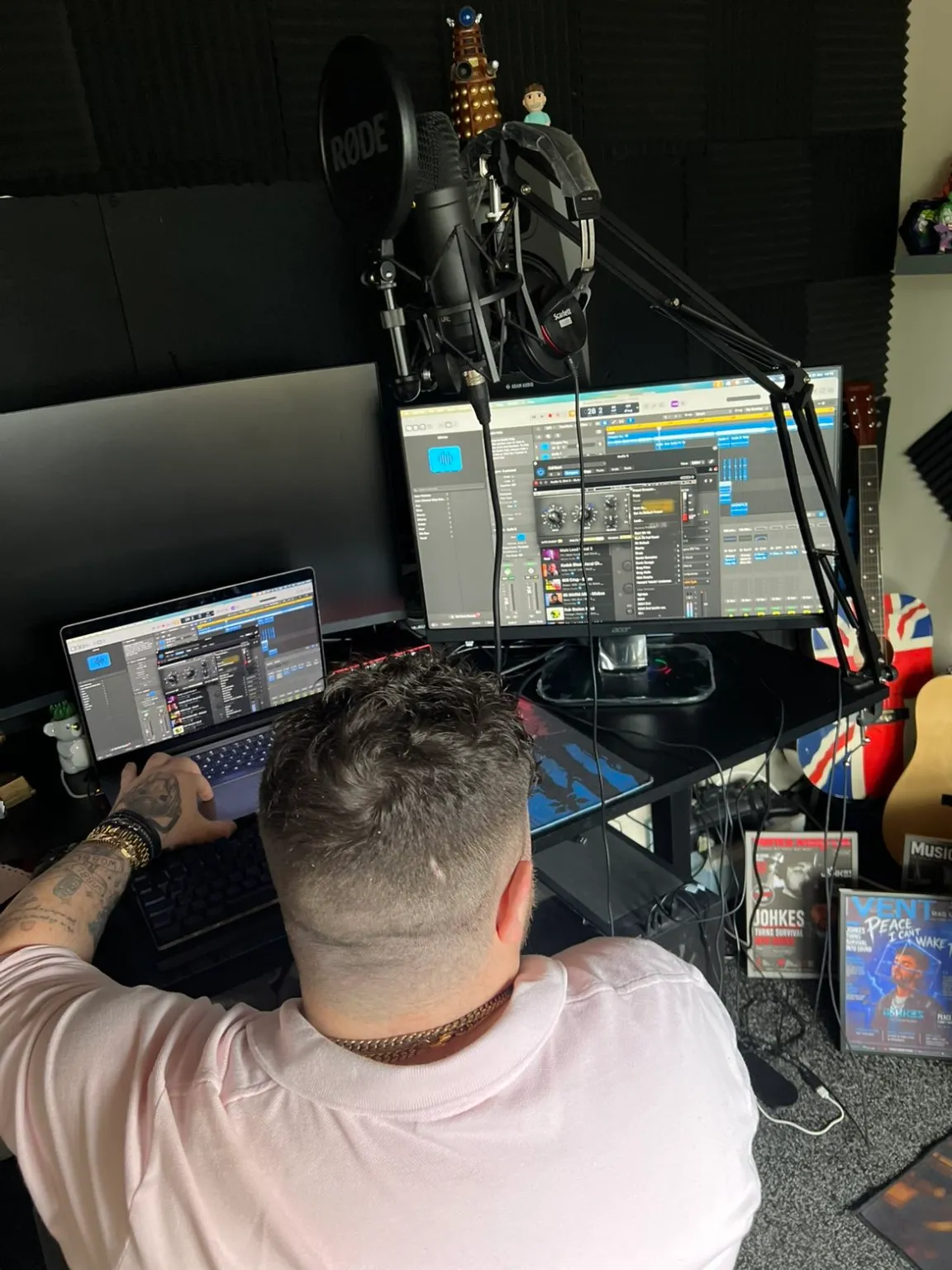
Mixing in Logic Pro. The chain he starts from was built on one long test take of the voice he has now.
What still gets in the way?
Now and then, something just out of reach. The odd volume knob or door still wins a round, and he finds that more funny than anything.
Sometimes it’s the simplest things. My Focusrite interface is at the back of my desk, and occasionally I can’t reach it to turn the output volume down when I want to record. I’ll ask my partner to help, and sometimes I need her to open the studio door too.
It’s funny really: I can record, produce and mix music independently, yet sometimes a volume knob or a door is what defeats me. Accessibility isn’t always about specialist technology — sometimes it’s simply about whether you can reach something!
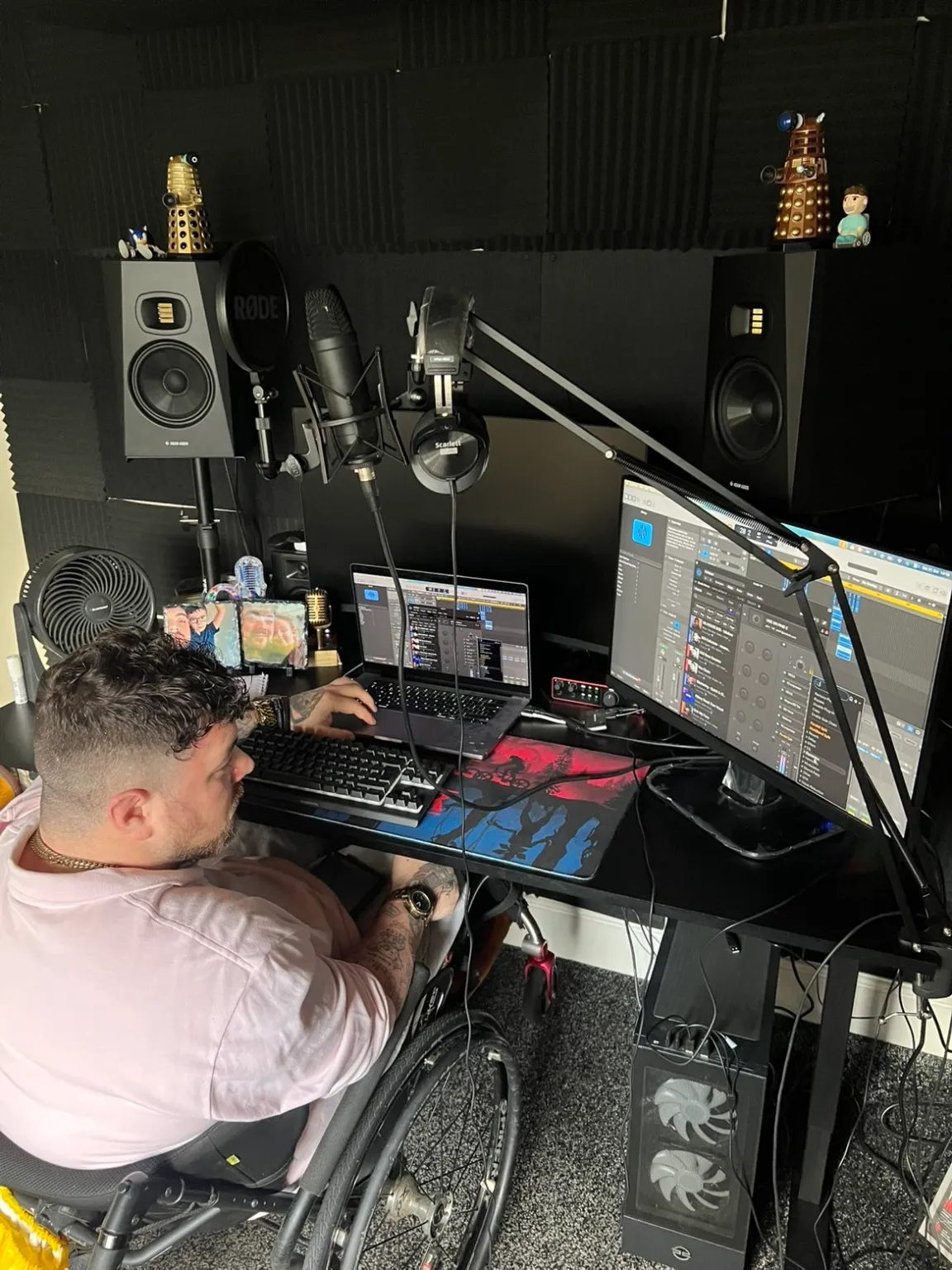
The red Focusrite, behind the laptop at the back of the desk. Every studio has one control that fights back, and this is his.
His last line is the one to take to your own studio, disabled or not. Accessibility is often less about specialist gear than about what’s within reach, so before you buy anything to make sessions easier, sit where you work and try every control a session needs from your own chair.
What would he tell other disabled musicians?
Do it your own way, and don’t worry about how it looks to anyone else.
I’d tell them to do it like nobody’s watching. You’ll find funny, stupid, unconventional ways of doing things, but they’ll be YOUR ways. If you really want it, believe me, you’ll find a way.
You don’t need to record everything in one take. If you’re like me and breathing isn’t easy, making music can actually teach you about your limits. You learn when to stop recording, when you need a breath, and eventually you start writing lyrics with those breathing points already in mind.
Don’t worry about whether your method looks strange to someone else. Find what works for you.
It’s the right place to end, because it’s what the whole interview has been showing. JOHKES writes, records, produces and mixes his own music, he found his own ways around everything that changed, and he’s clearly having a good time doing it, colorful language and all.
Most of us have a reason not to make music yet: the wrong gear, the wrong room, not enough time. He’s a pretty good argument for starting anyway, and for having some fun on the way. That’s what music, and any other creative work, is supposed to be about.
Key takeaways
- Record in sections if a full take costs you too much. Note where your breath or energy runs out, keep the take and pick up from that point. When a line goes wrong, record it again rather than patching one word. It keeps the momentum, and it beats editing your way out of a retake.
- Learn the voice you have now before you mix songs with it. One long test take, worked on until it suits you, saved as a starting chain that each song only adjusts.
- Write the breaths into the song, and let the adapted line stay yours. Once you know where you need a breath, the lyric can leave room for it. A delivery shaped around the voice you have is part of what makes the song sound like you.
- Keep what you need within reach before you buy anything new. Interface volume, monitor switch, the door. As he puts it, accessibility isn’t always about specialist technology.
- Find your own method, and ignore how it looks. His advice, and the one the rest of this list depends on.
About JOHKES
JOHKES is an independent rapper and songwriter, based in Lincoln and originally from Leicester. His 14-track album, Peace I Can’t Wake To, was released on 24 September 2026. In his words, it explores his experience following a road accident, a three-week coma and adjusting to life with tetraplegia, “alongside family, forgiveness and a questionable sense of humour”. He gave these answers in October 2026 and read the piece before it went up. Photographs supplied by JOHKES.
His music is on Spotify, and he is on Instagram and TikTok. Nothing here was paid for and no link in this piece is an affiliate link.
If you make music with a disability and have found your own way of doing something, tell us about it.
Thank you, JOHKES, for answering every question so openly, for the photos and for the laughs along the way. And if you’ve read this far, go and give Peace I Can’t Wake To a listen.