What Is a Split Sheet? Agreeing Song Splits Before You Release
The short version
A split sheet is a short signed record of who wrote a song and what share each writer owns. Fill it in at the session, before anyone registers or releases the song. It covers the composition; splitting the recording's streaming money is a separate step, which DistroKid and TuneCore can automate.
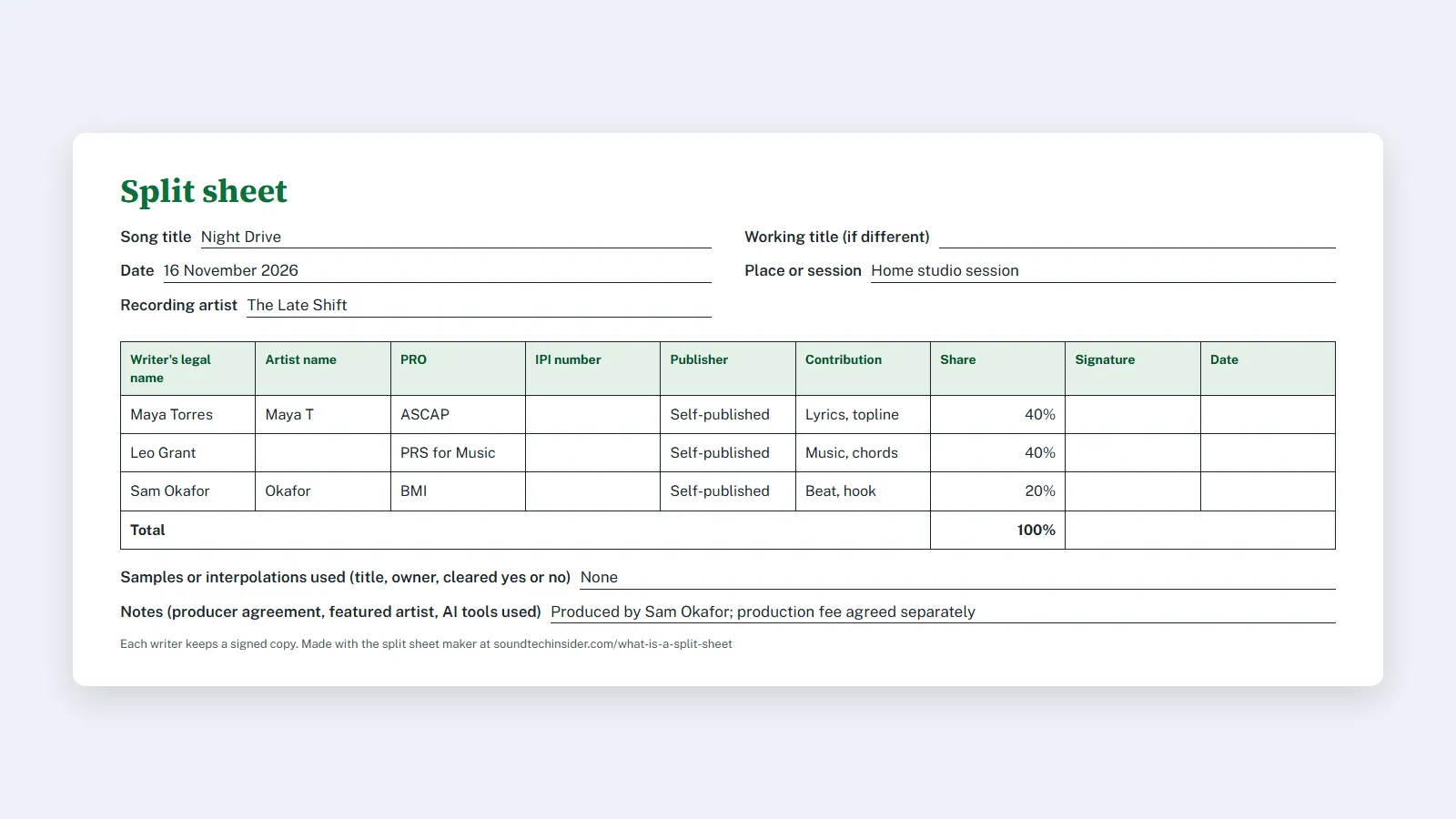
A split sheet is a short, signed record of who wrote a song and what percentage of it each writer owns. You fill it in when the song is finished, ideally before anyone leaves the session.
It takes five minutes, and it’s the document everyone reaches for when a song starts earning. So what goes on one, how do you agree the numbers, and how is it different from the splits your distributor offers? And when you’re ready, the split sheet maker further down lays one out for you.
What is a split sheet?
A split sheet is an agreement between co-writers that sets out each person’s share of a song’s composition: the melody, the lyrics and the music, as opposed to one particular recording of it. Everyone who wrote a part of the song signs it.
Those shares are what your collecting society (a PRO such as ASCAP, BMI or PRS) pays songwriting royalties against. When you register the song, the PRO asks for each writer and their percentage. The split sheet is where those numbers come from, and the proof if anyone later remembers them differently.
Do you legally need a split sheet?
No, but it’s the simplest evidence you’ll have if there’s ever a dispute. ASCAP, for one, leaves the percentages entirely up to the collaborators and says a written agreement isn’t required, while encouraging you to put one in writing.
It also matters when something has to change. If a registration needs correcting in a way that reduces someone else’s share, ASCAP may ask for signed confirmation from that person. A sheet signed on the day settles it before it becomes a problem.
What goes on a split sheet?
Everything a PRO or a publisher will ask for when the song is registered:
| Field | Why it’s there |
|---|---|
| Song title (and any working title) | So the sheet matches the registration, even if the title changes |
| Date and place of the session | Shows when the song was written |
| Each writer’s legal name | Royalties are paid to the legal name, not the artist name |
| Each writer’s PRO and IPI number | The IPI number identifies a songwriter across societies; it’s in your PRO account |
| Each writer’s publisher, if they have one | The publisher collects part of the royalties on the writer’s behalf |
| Each writer’s share, as a percentage | The whole point; the shares must add up to 100% |
| What each person contributed (optional) | Lyrics, melody, music; useful context if the split is questioned |
| Every writer’s signature and the date | Makes it an agreement rather than a note |
Keep a copy for every writer, and a scan or a photo is fine. The sheet only has to exist and be easy to find later.
How do you decide the split?
However the writers agree to, since there’s no rule. TuneCore’s help center lists the common patterns:
- Equal shares: every writer in the room gets the same, so a band of four takes 25% each. It’s the quickest, and it avoids weighing one line against another.
- By role: for example 50/50 between the person who wrote the lyrics and the person who wrote the music.
- A producer’s share: a producer who contributed to the composition may take part of the publishing, and TuneCore notes that some ask for 10–50% of it instead of a fee.
ASCAP’s view on producers is the useful test: if the producer contributed to the song itself (a chord progression, a hook, a topline), they can be credited as a writer. If they shaped the recording but not the song, their share belongs in a production agreement instead, usually a fee or a cut of the master.
Whatever you choose, agree it while everyone still remembers the session the same way. It’s a much harder conversation once a song has found an audience.
What’s the difference between a split sheet and DistroKid or TuneCore Splits?
They split different money. A split sheet divides the composition (the song), which earns through your PRO and your publisher. Distributor splits divide the recording’s earnings from streams and downloads, which come through your distributor.
- DistroKid Splits sends a share of a song’s or album’s earnings to each collaborator automatically. Each person sees only their own percentage, and a collaborator without a subscription can collect for $10 a year (checked November 2026). You can also set a recoupment, so one person is paid back an agreed amount before the split starts.
- TuneCore Splits does the same for distribution revenue, track by track, but only on its paid Unlimited plans, and not retroactively. TuneCore says plainly that publishing revenue isn’t included.
So a co-written song released on DistroKid can need both: a split sheet for the songwriting, and a Splits setup for whoever shares in the recording. The two don’t have to match, either. A featured vocalist might take a share of the master and none of the publishing, or the other way round.
Make a split sheet now
Fill in the song and each writer below. The maker checks that the shares add up to 100% and lays everything out as a sheet you can print or save as a PDF, ready for everyone to sign.
Split sheet maker
Fill it in at the session, check the shares add up to 100%, then print it or save it as a PDF for everyone to sign. Nothing you type is sent anywhere or saved, so print it before you close the page.
A split sheet template you can copy
Download the free split sheet template (PDF): one page, landscape, with room for six writers. Print a few and keep them with your gear.
Or copy this into a document, fill one in per song, and have every writer sign it:
Split sheet
Song title: ______________________ Working title (if different): ______________________
Date: ____________ Place / session: ______________________
Recording artist: ______________________
Writer’s legal name Artist name PRO IPI number Publisher (if any) Contribution Share (%) Signature Total: 100%
Samples or interpolations used (title, owner, cleared yes/no): ______________________
Notes (producer agreement, featured artist, AI tools used): ______________________
The last two lines are there because they come up later. An uncleared sample can claim part of the song, and ASCAP currently accepts partially AI-generated works but not fully AI-generated ones, so it’s worth noting what was made by whom.
Key takeaways
- A split sheet records who wrote the song and who owns what share, signed by every writer.
- Fill it in at the session, before anyone registers, uploads or releases anything.
- Legal names, PRO, IPI number, publisher and percentage are what a PRO will ask for.
- There’s no standard split. Equal shares, by role, or a producer’s share all work if everyone agrees.
- Distributor splits are a different thing: DistroKid and TuneCore Splits share the recording’s earnings, not the songwriting.
Our recommendation
Make the split sheet part of finishing a song, the way bouncing a rough mix is. Print a few, or keep the template on your phone, and fill one in before the session ends. Nobody minds a five-minute form when everyone’s excited about the song.
If you can’t agree a split on the day, you’ve learned something important before it cost anything: settle it before the song goes anywhere. And once it’s signed, register the song with your PRO using the same numbers, so the paperwork and the payments say the same thing.