DistroKid Pricing Guide - Everything You Need To Know
Some links on this page are affiliate links. If you buy through them, Sound Tech Insider may earn a commission at no extra cost to you. How this works.
Short answer
Musician Plus is the DistroKid plan most independent artists want. Here is what all three cost, every extra priced, and the fees that catch people out.
On this page
- What does DistroKid actually do for the money?
- How much does DistroKid cost?
- Musician
- Musician Plus
- Ultimate
- Can you pay for DistroKid monthly?
- Can you downgrade to a cheaper plan?
- What are DistroKid’s extras?
- How much does DistroKid’s YouTube Content ID cost?
- What are DistroKid’s hidden costs?
- Musician Plus or Ultimate: which do you need?
- Which plan do labels need?
- Which DistroKid plan should you choose?
- Our recommendation
- Key takeaways
So you’ve decided to put your music on Spotify and Apple Music, and DistroKid keeps coming up. Good instinct — it’s one of the cheapest ways to get there.
The subscription isn’t the confusing part. The confusing part is the Extras window that appears at the end of the upload flow, after you’ve already paid, offering a dozen add-ons you’ve never heard of.
This guide covers all of it: what each plan costs, what every extra does, which ones we think are worth the money, and which plan to pick for the way you actually release music.

What does DistroKid actually do for the money?
Worth being clear about this before the prices, because it’s where expectations tend to go wrong.
DistroKid delivers your music to online stores and streaming services, collects the royalties, pays them to you, and shows you basic stats. You keep 100% of your earnings, and you can set up splits so collaborators are paid automatically.
What it doesn’t do is promote you. There’s no artist development and no marketing. A distributor puts your music where people can find it; finding them is still your job.
It’s priced like software, too. You pay a yearly fee, you release as much as you like, and that fee is what keeps your catalog in stores.
How much does DistroKid cost?
Three plans, all billed by the year:
| Plan | Price | What you get |
|---|---|---|
| Musician | $24.99/year | 1 artist or band; unlimited songs and lyrics |
| Musician Plus | $44.99/year | 2 artists or bands; adds synced lyrics in Apple Music, daily streaming stats, custom label name and release dates |
| Ultimate | $89.99/year | 5 artists and up (packages up to 100); adds advanced analytics, file sharing and Spotify and Apple Music monitoring |
Prices checked October 2026. Check current prices before you buy.
Our referral link takes 7% off any of them, which brings Musician Plus to $41.84 per year: claim the 7% discount.
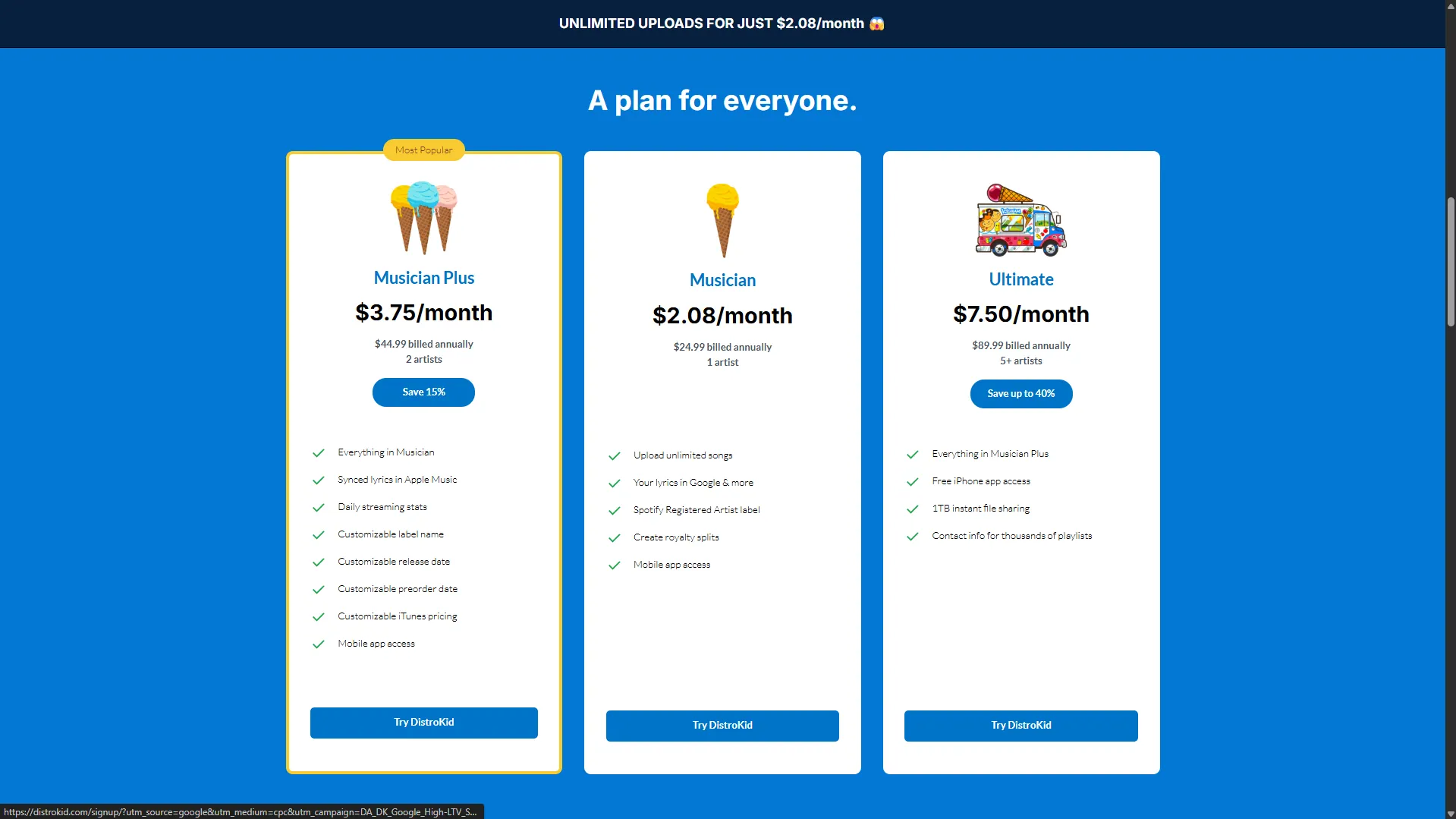
DistroKid’s pricing page, October 2026.
One thing to check before you budget: these are the prices DistroKid quotes in US dollars. It charges in local currency elsewhere, and the amounts aren’t a straight conversion — each region’s price is set on its own, so the euro figures don’t line up with the dollar ones at any single exchange rate.
DistroKid also runs promotions on top of all this — the day we captured the page it was offering a saving on Musician Plus and a larger one on Ultimate. Those come and go, and they often apply to a first year rather than every year, so we don’t quote the percentages here: whatever we printed would be wrong within weeks. Check the page for what’s running when you sign up.
Musician
$24.99 per year, for one artist or band name.
You get unlimited songs and albums, lyrics, royalty splits and a verified artist profile on Spotify, and you keep every cent of your royalties.
For a solo artist releasing under a single name, this really is enough to start.
Musician Plus
$44.99 per year, and the one most people should buy.
It adds a second artist name, your own label name, control over release dates, pre-order dates and iTunes pricing, synced lyrics in Apple Music, and daily streaming stats.
Two names on one plan cost less than two Musician plans, so a band plus a solo project pays for the upgrade by itself.
The release-date control is the part we would pay for even without the second name. Choosing your own date is what makes a release plannable: you can pitch ahead of time, line up posts and open pre-orders.
Ultimate
From $89.99 per year, which covers five artists. Packages run up to 100, and the price moves with the count; DistroKid lists each one on its pricing page.
On top of Musician Plus you get advanced analytics, monitoring of your music on Spotify and Apple Music, a search for playlist contacts, 1 TB of file sharing, and the ability to replace a song’s audio after release.
This is a label plan, and it’s priced like one.
Can you pay for DistroKid monthly?
No — and DistroKid’s own pricing page makes that easy to misread.
The number it shows biggest on each plan is a monthly one. Underneath, in smaller type, is “billed annually”. That monthly figure is the yearly price divided by twelve, not a subscription you can pay month to month.
You pay for a full year, up front.
That’s the model rather than an oversight — the annual fee is what keeps your releases live, and if you stop paying, they come down. (Unless you bought Leave a Legacy, which is further down this page.)
The only thing DistroKid bills monthly is the Beatport add-on, at $9.99 per month.
Can you downgrade to a cheaper plan?
Yes — though DistroKid’s own pricing page suggests otherwise, which is why so much of the internet says you can’t.
Here is what we saw. Signed in on an account whose Musician Plus membership had been canceled, the Compare Plans table offered Ultimate and Musician Plus but showed the cheaper Musician plan as “Not available” (it’s in our screenshot further down this page). The account’s own membership panel offered two things, neither of them a downgrade:
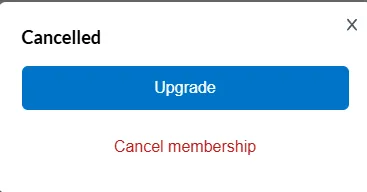
The membership panel on a canceled Musician Plus account, October 2026. Upgrade, or cancel. No way down.
That dead end is where the widely repeated advice comes from: cancel your membership, open a new account under a different email address, and re-upload your catalog. It’s on forums and in videos, and it would be a miserable afternoon — your releases lose their links, their stream counts and their release dates.
You don’t have to do any of that. DistroKid’s support pages describe a downgrade path that doesn’t go through the pricing page at all: open your Account page, click Manage Membership at the bottom, then Downgrade, and pick the plan you want.
Two things to know about it. The change lands on your next renewal date rather than immediately — you keep what you’re paying for until then, and you aren’t refunded the difference. And a scheduled downgrade can be called off from the same screen if you change your mind.
So the practical advice is about timing, not about which account you use: if you’re dropping a tier, schedule it before your renewal comes round.
One piece of honesty about the above. We couldn’t put the downgrade through ourselves, because the membership on the account we checked had already been canceled — and a canceled membership has nothing to move down from, which is the likeliest reason the option wasn’t on screen. If you’re on an active plan and you can’t find Downgrade either, tell us and we’ll say so here.
What are DistroKid’s extras?
Here’s where the questions start.
When you’ve finished filling in a release, DistroKid shows an Extras window: a list of paid add-ons, presented after you’ve paid for your subscription and seconds before you publish. That is the worst possible moment to be making decisions about money.
It’s understandable that DistroKid upsells, given how cheap the plans are, but it would still be nice to be told beforehand. So here’s the whole list:
| Extra | Price | What it does |
|---|---|---|
| Discovery Pack | $0.99 per song, per year | Adds the release to music-recognition and credits databases (Gracenote, Luminate/SoundScan, ACRCloud, Jaxsta) |
| Store Maximizer | $7.95 per album, per year | Delivers the release to new stores and streaming services as DistroKid adds them |
| Social Media Pack (single) | $4.95 per single, per year, plus 20% of ad revenue | Registers the tracks with the rights databases at YouTube (Content ID), TikTok, Instagram and Facebook, so you're paid when videos use them |
| Social Media Pack (album) | $14.95 per album, per year, plus 20% of ad revenue | The same, for an album |
| Beatport | $9.99 per month | Unlimited delivery to Beatport; electronic genres only |
| Audiomack | Free | Free delivery to Audiomack; needs an Audiomack account |
| Cover song licensing | $12 per cover song, per year | Required for every cover song you upload |
| Leave a Legacy (single) | $29 per single, one-time | Keeps the release in stores even if your membership lapses or you cancel |
| Leave a Legacy (album) | $49 per album of 2+ tracks, one-time | The same, for an album |
| Dolby Atmos | $26.99 per track, one-time | Marks a track mixed in Dolby Atmos as available for spatial audio (Apple Music, Tidal, Amazon) |
| Loudness Normalization | $2.99 per track, one-time | Adjusts the audio to Spotify's recommendation (-14 LUFS integrated, -1 dB true peak) |
Prices checked October 2026. Check current prices before you buy.
Every one of them is optional. Most of them you don’t need. These are the ones worth a closer look.
Social Media Pack — $4.95 per single, per year, plus 20% of ad revenue
The YouTube Content ID one, and the only extra we would actively recommend. It carries enough fine print to deserve its own section, which is right below this list.
Discovery Pack — $0.99 per song, per year
Registers the release with the databases that recognize and credit music: Gracenote (the song recognition built into millions of cars and devices), Luminate/SoundScan (the data behind the Billboard charts), ACRCloud (audio fingerprinting) and Jaxsta (official credits).
Under a dollar a year per song is cheap for having your credits listed properly and your audio identifiable.
Worth considering. Not essential.
Store Maximizer — $7.95 per album, per year
Delivers your release to new stores and services as DistroKid adds them, and tells you each time it does.
Every major platform is already covered without it, and you can ask DistroKid to deliver to a new store yourself at no charge. So this buys convenience, not reach.
Skip it unless you have enough releases that doing it by hand would genuinely be a chore.
Loudness Normalization — $2.99 per track, one-time
This adjusts your track to Spotify’s recommendation: -14 LUFS integrated, with a -1 dB true peak ceiling. (LUFS measures how loud something actually sounds, rather than how high the waveform peaks.)
The streaming services normalize playback anyway. If your master is louder than their target, they turn it down on the way out; paying to have it turned down earlier doesn’t win you anything. And if your level is wrong, that’s a decision to make while mixing and mastering, where you can hear what it does.
We consider this one completely unnecessary.
Leave a Legacy — $29 per single, $49 per album, one-time
Keeps a release in stores permanently, even if your membership lapses or your card is declined. Royalties keep accruing, and you can still take it down yourself if you ever want to.
Per single, it costs more than a full year of the Musician plan, so for an artist who’s actively releasing, just keep the subscription running. Where it earns its place is on a release you want to outlive the account.
Cover song licensing — $12 per cover song, per year
Not an upsell — a legal requirement. Uploading someone else’s song needs a mechanical license, and this is how DistroKid gets you one. It renews yearly, per cover.
If covers are a big part of what you release, budget for this properly: five covers is five licenses, every year, on top of your plan.
Dolby Atmos — $26.99 per track, one-time
Flags a track as a spatial audio mix for Apple Music, Tidal and Amazon, one-time, per track.
Only relevant if the track was genuinely mixed in Atmos. It doesn’t convert anything for you.
Delivery to Audiomack, for what it’s worth, is free. It just needs an Audiomack account.
Also Read: “Music Promotion in The Digital Age: 10 Proven Strategies For Independent Musicians”
How much does DistroKid’s YouTube Content ID cost?
Two charges, and most people only hear about the first one.
Content ID comes through DistroKid’s Social Media Pack. It costs $4.95 per single or $14.95 per album, every year, on every release you add it to. Ten singles means ten annual fees, not one.
Then DistroKid keeps 20% of the ad revenue it recovers for you. If matched videos earn $100 across a year, $80 reaches you.
What you get for that: your tracks are registered with the rights databases at YouTube, TikTok, Instagram and Facebook, and scanned for matches. When someone else’s video uses your music, the ad money goes to you instead of to whoever uploaded it.
Whether it’s worth paying comes down to one question: is anyone actually using your music? On a release nobody has found yet, you’re paying an annual fee, plus a fifth of nothing, to protect revenue that doesn’t exist. On a track that is being used in videos, it’s the one extra here that can pay for itself several times over.
So add it when you can see the demand rather than ahead of it. Skipping it at upload doesn’t lock you out: DistroKid’s support pages describe adding extras to a release afterwards, from the release page in your dashboard.
What are DistroKid’s hidden costs?
Nothing is hidden exactly — it’s all listed — but three things catch people out.
The extras are annual, and per release. The Discovery Pack, Store Maximizer and the Social Media Pack all renew every year, on each release you put them on. A back catalog of ten singles carries ten of every fee you opted into.
The Social Media Pack costs more than its price. DistroKid keeps a fifth of the ad revenue it recovers, on top of the annual fee. The section above works through when that is still worth paying.
Covers need a license every year. $12 per cover song, per year, renewed annually, which mounts up on a covers-heavy catalog.
And the one that isn’t a fee at all: stop paying, and your music comes out of the stores.
Musician Plus or Ultimate: which do you need?
Almost everyone reading this wants Musician Plus.
Ultimate is built around managing other people’s music — several artist slots, analytics across a roster, monitoring, audio replacement after release. Those are label problems, and if you don’t have them, you’re paying for tools you won’t open.
DistroKid’s own comparison shows where the line falls:
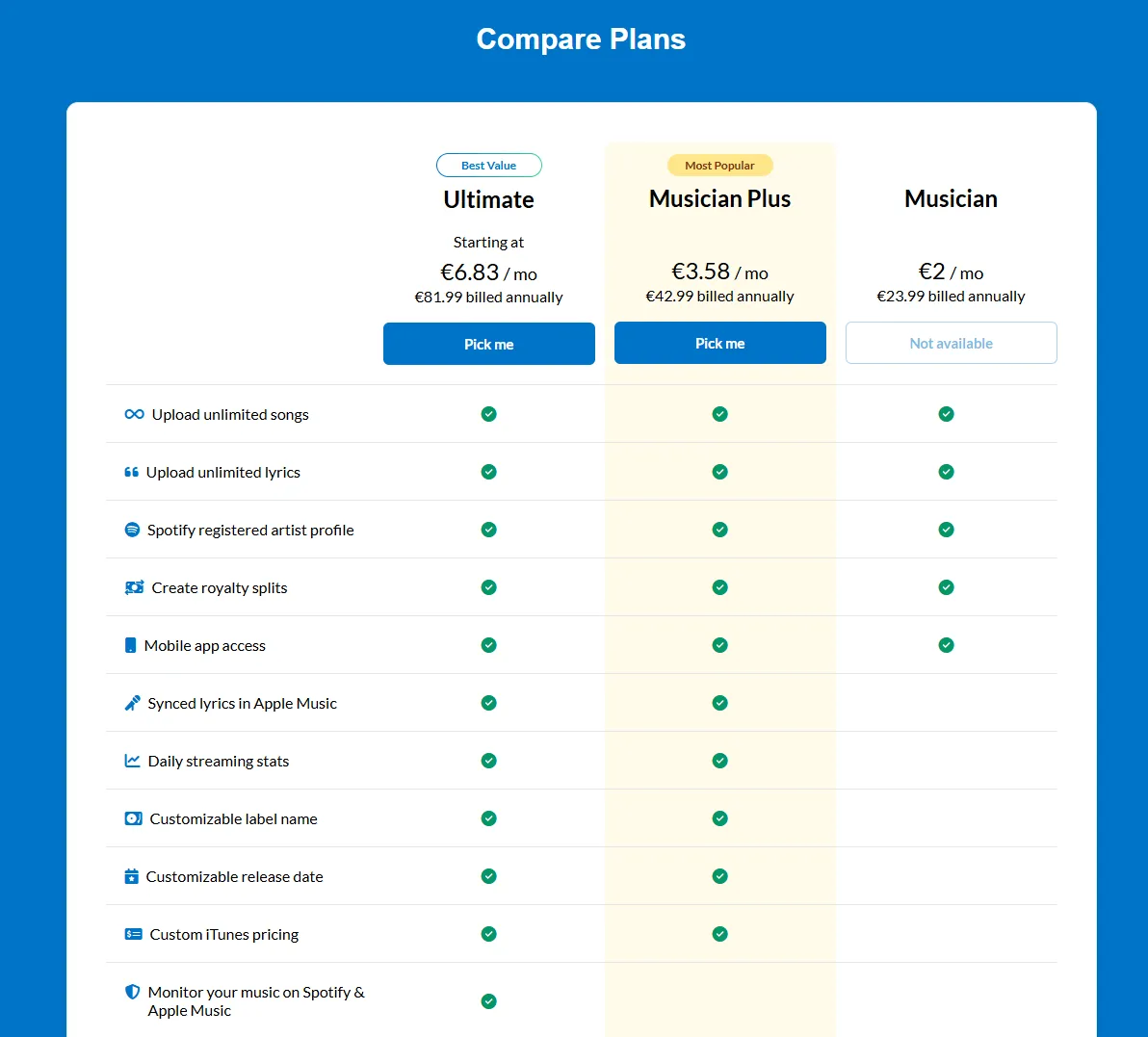
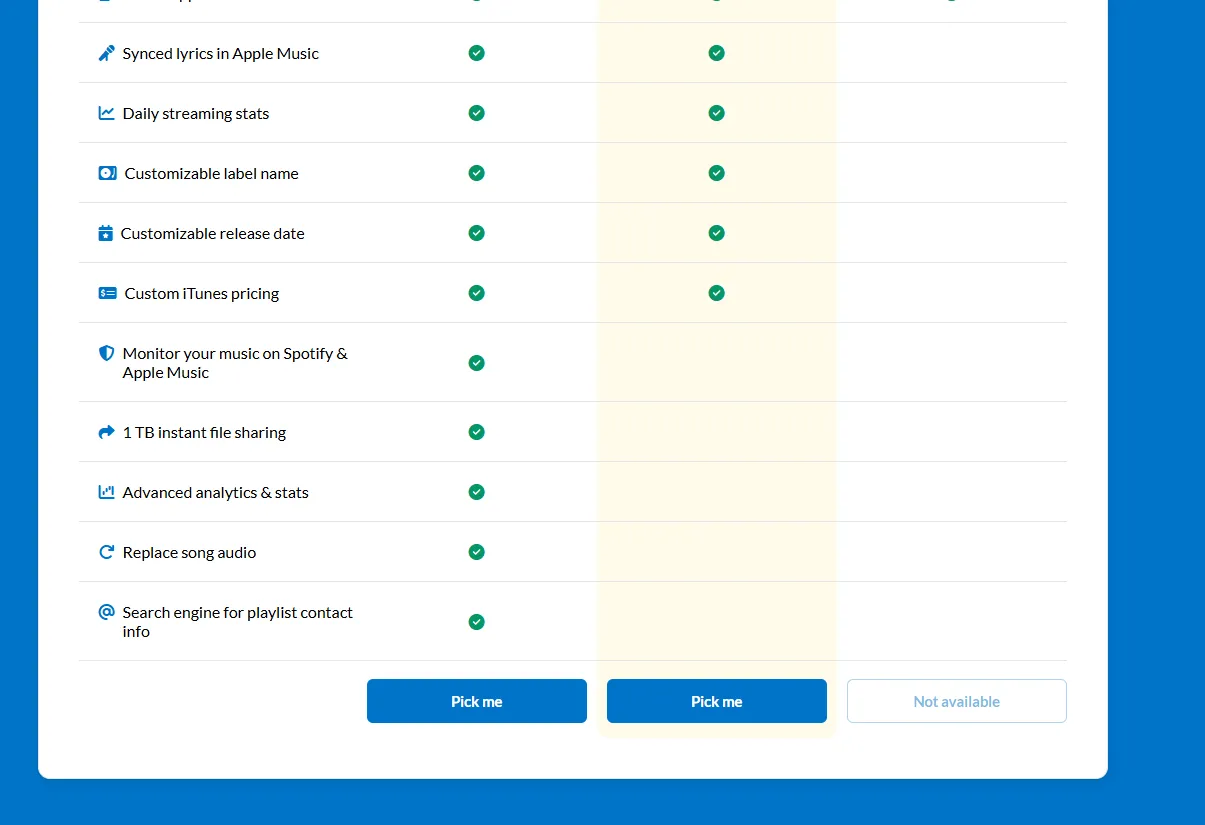
The same table, top and bottom. Everything below Custom iTunes pricing is Ultimate only. Captured October 2026 on a canceled Musician Plus account, which is why the Musician column reads “Not available” — see Can you downgrade to a cheaper plan? above. The prices in this view are in euros, because DistroKid quotes each region in its own currency.
Move up to Ultimate when you’re releasing music for artists who aren’t you, or when you need a third artist name — though be aware there’s no small step up. Musician Plus stops at two names and Ultimate starts at five, so a third name means buying five slots. Don’t move up for the analytics: as a single artist, Spotify for Artists tells you what you need for free.
Which plan do labels need?
Pick by the size of your roster and buy the package that matches it.
Ultimate starts at five artists and scales to 100, with the price moving with the count, so there’s nothing to gain by buying ahead of where you are. You can upgrade when you sign someone.
Which DistroKid plan should you choose?
Work down this list and stop at the first one that fits:
- One artist name, and you don’t mind DistroKid choosing your release date? Musician.
- One artist name, but you want to plan the release? Musician Plus, for the date and pre-order control.
- A band and a solo project, or two aliases? Musician Plus — cheaper than two Musician plans.
- Three or more artist names? Ultimate — its smallest package covers five, so you pay for five either way.
- Releasing other artists’ music? Ultimate.
- Releasing mostly covers? Any plan works, but add the license fee per cover, per year, to whatever you budget.
Our recommendation
If you’re an independent musician: Musician Plus, at $44.99 per year.
It isn’t really about the second artist name, useful as that is later. It’s that your release date, your pre-order window and your own label name are the parts of a release you need to control, and they all live on this plan. Choosing the date is the difference between promoting a release and just publishing one.
If money is tight, Musician does the job, and you can upgrade part-way through the year.
If you’re a label: Ultimate, sized to your roster and upgraded as it grows.
And about the extras: one is worth paying for, the Social Media Pack, and only once your music is being used in videos. The Discovery Pack is cheap enough to be a fair yes if credits matter to you. Cover licensing isn’t optional if you release covers. The rest we’d leave unticked.
Key takeaways
- Most independent artists want Musician Plus ($44.99 per year) — for the release-date control, not the second artist name.
- Ultimate is a label plan. Buy it to manage other artists, not for the analytics.
- DistroKid is yearly only, and a downgrade waits for your renewal date. Stop paying altogether and your releases come down, unless you bought Leave a Legacy.
- Of the extras, only the Social Media Pack earns its fee — and only once your music is actually being used in videos.
- Budget cover licenses separately. Per cover, per year, for as long as the release is up.
Our full test of the platform, including the upload flow and getting paid, is in the DistroKid review. If you just want the cheapest way in, we keep the discounted prices on one page: DistroKid deals.
Ready to sign up? Our referral link takes 7% off.