Sponsored This piece was sponsored by ADB Records. The questions and the hands-on notes are ours. Our editorial standards still apply.
A Reverb Built Around Mic Technique: André de Brito on ADB Room Mics
The short version
ADB Room Mics is a free room reverb you set up like a recording session: pick a mic pair, place it in a room and decide what it hears. Its maker, acoustical engineer André de Brito, explains how to choose between AB, XY, Blumlein and ORTF, when the dummy-head mode helps, and what home studios get wrong about the room.
On this page
- Who built ADB Room Mics?
- Why build a reverb around microphone technique?
- Which stereo mic technique should you use: AB, XY, Blumlein or ORTF?
- What does the dummy-head “Ears” mode do?
- Are the rooms in ADB Room Mics real?
- What do home studios get wrong about the room?
- Why is ADB Room Mics free, and why is there no AAX version?
- What is ADB Room Mics like to use?
- What’s next from ADB Records?
- Key takeaways
- About André de Brito
ADB Room Mics is a free reverb plugin that starts where a recording engineer starts: with the microphones. Instead of a size knob and a decay knob, you choose a mic pair, place it in a room and decide what it captures. The room can be a modelled concert hall, church or studio, or one you shape yourself.
It’s made by André de Brito, a Portuguese singer-songwriter with a background in physics and acoustical engineering. He released it as freeware, free for commercial use, and keeps it going on donations.
We asked him about the decisions behind it: why microphones, how to choose a stereo pair, what the dummy-head mode is for, and what people recording at home get wrong about their rooms. The questions are ours and the answers are his, lightly edited.
Who built ADB Room Mics?
An acoustical engineer who also makes records. The plugin side is very new, and he’s open about how he builds it.
 André de Brito Singer-songwriter and acoustical engineer
I studied Physics Engineering in Portugal and later completed postgraduate studies in Acoustical Engineering at Salford University. I also studied music at the University of Surrey and at several private schools in Portugal. I’ve always been involved in music as a singer, songwriter and music producer.
Professional studio time was expensive, so I gradually bought equipment, built a decent home studio and learned how to produce, mix and master my own recordings.
Plugin development is extremely new to me; I only started a couple of weeks ago. I’m not a programmer, and I’ve been using AI-assisted coding guided by my background in acoustics, music and sound. That background helps me define what the plugin should do, assess the results and identify what needs improving.
ADB Room Mics started as a personal project, which I then decided to share. I’m already busy with acoustics and music, and I didn’t want the additional commitments of running a commercial software product. That’s why I chose to release it as freeware.
Why build a reverb around microphone technique?
Because it began as a drum room, and the question that mattered was where to put the mics.
The initial idea was to model a simple drum room and experiment with different microphone techniques, using Steven Slate Drums as the starting point. The first versions had a drum kit in a fixed position, and you could only move the microphones closer or further away.
From there I gradually expanded the plugin. The microphone approach stayed central because it gives you a recording engineer’s way of thinking: where would I place the microphones, and how would I capture this room? Size and decay still matter, but the microphone technique and position give you another way to shape the sound.
The model also accounts for instrument directivity: how an instrument radiates sound in different directions. You can switch that off and use an omnidirectional source if you want to keep the original source. For a more neutral microphone perspective, you can choose a mono omni or an AB pair with the Neutral mic type.
Which stereo mic technique should you use: AB, XY, Blumlein or ORTF?
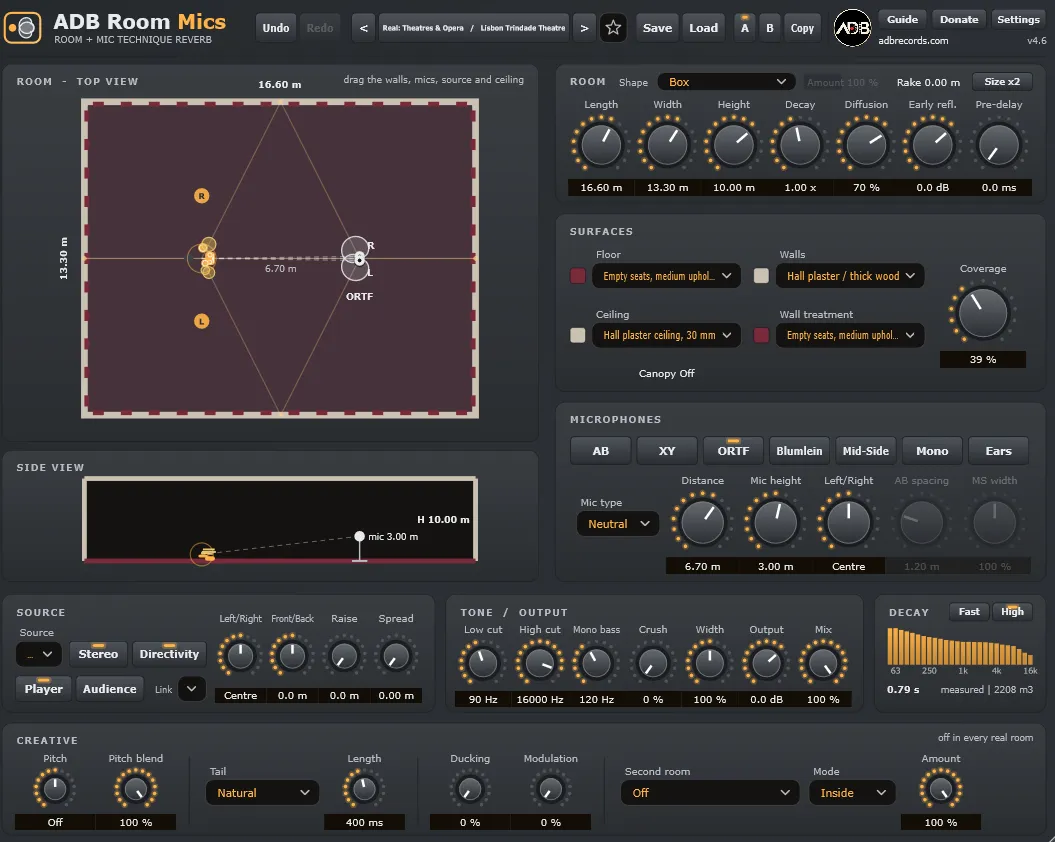
A quick key first. AB is a spaced pair of microphones a distance apart. XY puts two directional mics at the same point, angled away from each other. Blumlein is a coincident pair of figure-of-eight mics at 90 degrees, which hears the room behind as well as the source in front. ORTF places two directional mics 17 cm apart, angled 110 degrees.
AB would be a starting point for a spacious image, XY for a more focused image with good mono compatibility, Blumlein when the room itself is an important part of the recording, and ORTF for a balance of width and definition.
The same principles apply inside the plugin, but you don’t have to match the technique used in the original recording. If something was recorded with ORTF, for example, you can still use AB as your virtual room pair. You’re choosing how to capture the added room around that recording.
With an existing stereo recording, I would preserve its image using the Stereo source option, then choose the virtual microphones according to what the mix needs. I would also consider how much room is already present: a dry recording gives you more freedom, whereas a naturally ambient recording may need only a subtle addition.
What does the dummy-head “Ears” mode do?
It swaps the microphones for a listener. KEMAR is a standard acoustic mannequin, a head and torso with ears, used to measure how a human head changes the sound that reaches each ear.
Ears changes the perspective from microphones capturing a room to a listener being inside it. It uses measured KEMAR head-related transfer functions to represent how the head and ears affect sounds arriving from different directions.
The differences include timing, level and frequency response. On headphones, those cues can give a stronger impression of being in the space.
It would not be my automatic choice for every mix. The effect depends on the listener and the playback system, and a conventional pair may give a more suitable image when working mainly for loudspeakers. Ears is another listening perspective rather than an upgrade over all the microphone techniques.
Are the rooms in ADB Room Mics real?
They’re modelled on real ones, and checked against measurements of them. A room that fails the check doesn’t ship.
The venues weren’t captured by me on location. I used published acoustic measurements, along with documented dimensions and materials where available, to recreate real spaces within my model. The calculated decay and other relevant information is checked against the measured data across frequency, rather than relying on a single reverberation-time value. If a room doesn’t meet the validation criteria, it isn’t included in the plugin.
I kept adding information and drastically improving the plugin on every release, and now it’s quite complex but still easy to use. You can choose different shapes of room, control early reflections and, of course, change the materials inside the room. It can be an extremely creative tool. There are over 300 presets to choose from as well, if you don’t want to dabble with all the parameters.
So it isn’t strictly a measured-versus-algorithmic distinction. ADB Room Mics generates its responses computationally, but the models of real spaces are informed by actual measurements. Those measurements provide a reference for the behaviour of a particular venue, while the model still allows you to move the source and microphones.
A measured space isn’t automatically better sounding. What is interesting is its particular acoustic character, including how different frequencies decay, rather than simply a generic “large hall” sound. The aim is to recreate those characteristics without claiming that every detail of the original venue has been reproduced.
I also expanded the creative side of the plugin, drawing on both acoustics and music production. I added gated and reverse reverb, ducking and modulation, alongside more unusual options such as coupled rooms, placing one room inside another, and combining the early reflections of one room with the reverberation tail of another. That lets you start with a physically grounded space and then take it somewhere more experimental.
What do home studios get wrong about the room?
Mostly, how much it’s already shaping what you hear, and where you sit in it.
I think people often underestimate how much the room affects both recording and listening. Even without an obvious reverb tail, early reflections and room modes can strongly colour what you hear. At low frequencies, those modes create peaks and dips that depend on where the source and listener are positioned.
Speaker placement and the listening position are particularly important. I’ve seen setups with the listener right in the middle of the room, which can be a problematic position because of deep modal cancellations. You might then try to correct a lack of bass in the mix when the problem is actually where you’re sitting.
There is also a tendency to think acoustic treatment is unnecessary, or that a few (or a lot of) thin foam panels will solve everything. Appropriate treatment matters, particularly for controlling low-frequency problems.
With a clean, dry recording, ADB Room Mics can add space, depth and a shared acoustic setting for separately recorded instruments. But it cannot remove the room already captured in a recording, or fix the acoustics of your listening environment. Good placement and suitable treatment remain the foundation for making reliable recording and mixing decisions.
Why is ADB Room Mics free, and why is there no AAX version?
Because signing costs money, and a free plugin has no sales to pay for it.
There isn’t one single signing cost covering all of those. Windows and macOS have different code-signing and distribution processes, while AAX is a plugin format with its own requirements. ADB Room Mics doesn’t currently include a native AAX version.
I haven’t paid for all those processes myself, so I wouldn’t want to give an inaccurate total. My own decision was that, having already invested countless hours in development and testing, I didn’t want to take on additional signing expenses for a project I’m giving away.
For freeware developers, there is no income from sales to cover those expenses. I want to keep ADB Room Mics free, and donations help support its continued development.
That has two practical consequences, which he pointed out himself. Pro Tools users are out of luck for now, since Pro Tools only loads AAX. And because the plugin isn’t code-signed, Cubase blocks it the first time: open the Plugin Manager, find ADB Room Mics in the blocklist and reactivate it, and it works normally after that. On macOS, installing can take a little more care, but copying the plugin files into place by hand works.
What is ADB Room Mics like to use?
I tried version 4.6 in REAPER on Windows, on an acoustic guitar track. The VST3 and CLAP versions both showed up in REAPER’s plugin list, and nothing was blocked, so the Cubase step above wasn’t needed.
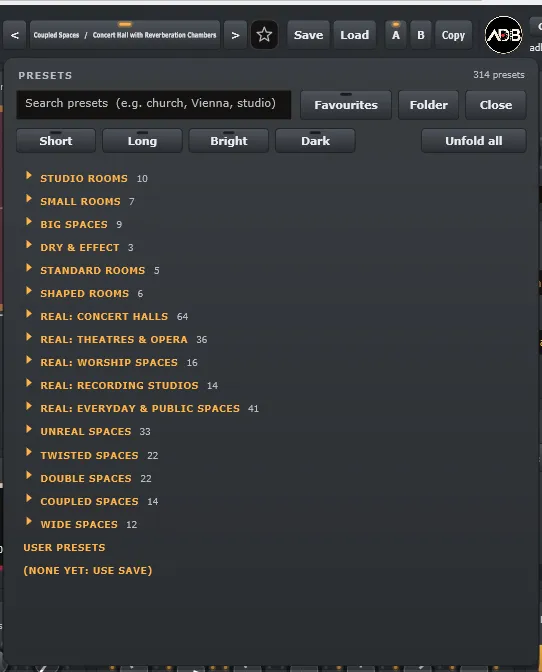
The first thing that struck me was the presets: how many there are, and how well they’re organized. There are 314, in folders that run from studio rooms and small rooms to real concert halls, theaters, worship spaces and recording studios, with a search box, favorites and quick filters for short, long, bright and dark. I ended up visiting a few places I know. I’m Portuguese as well, and the Theatres & Opera folder alone has Lisbon’s Trindade and São Carlos, Porto’s São João, and the municipal theaters of Faro and Guarda.
Switching between AB, XY, Blumlein and ORTF on the same guitar, the changes are subtle, but they sound realistic. From my own experience with these pairs, I can hear the emulation doing its job.
Ears did what André describes: on headphones, it gave a stronger sense of being inside the room. How much you get from it will vary a lot with what you’re listening on, since that’s what finally decides how the audio reaches you.
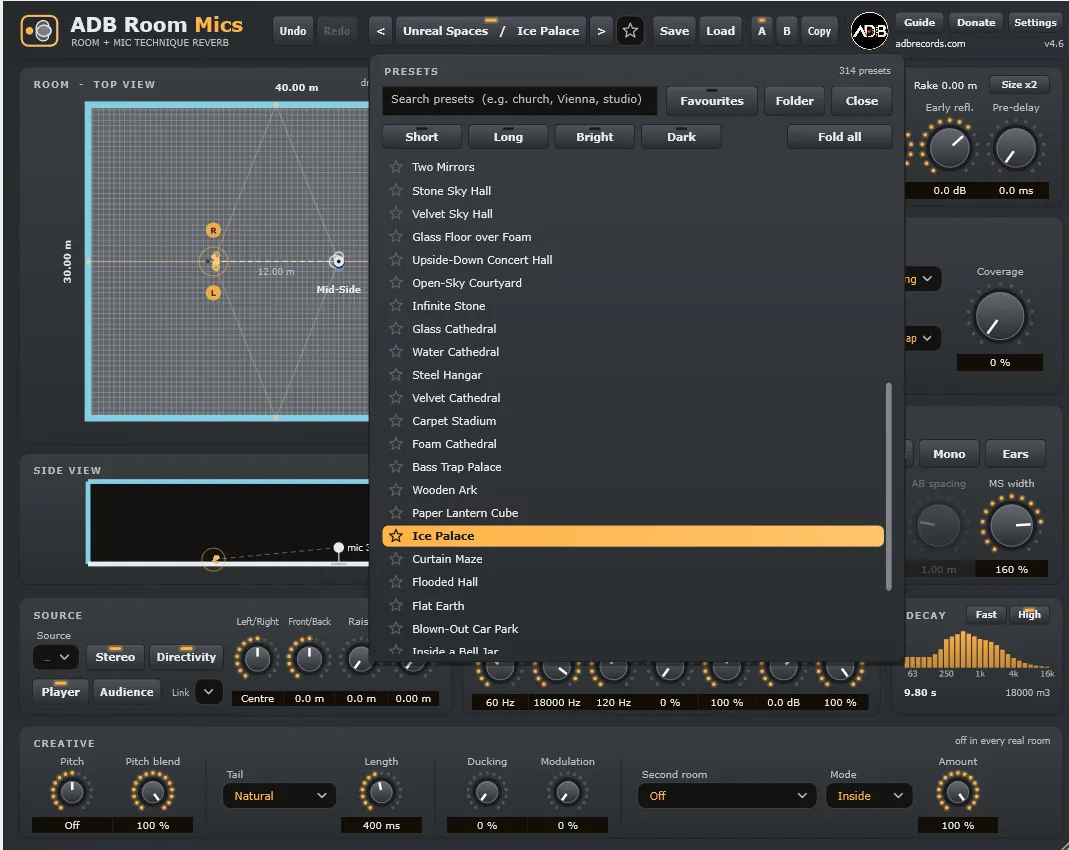
For something no architect would sign off on, I also tried Ice Palace, from the Unreal Spaces folder: a 40 by 30 meter room with a 9.8-second decay. I also develop games on the side, and this is one I can see myself using in my own projects. If a game ever needs a literal ice palace, the preset is an easy way to get there.
One tip before you install it: if you’re not sure where to start, pick a room you’ve actually been in. Knowing how it sounds in person makes it much easier to hear what the plugin is doing.
ADB Room Mics comes as VST3, AU, CLAP and LV2, for Windows and macOS, according to its product page (version 4.6 in November 2026). A second plugin, Surround, covers layouts from LCR up to 7.1.6, plus first-order Ambisonics.
What’s next from ADB Records?
Two more free plugins, both built for his own sessions first.
I’m working on two more personal projects, due to sheer necessity, which will be out soon.
ADB Vocal Align came from my recent transition from Cubase to REAPER. I record a lot of vocal takes and harmonies, and I liked how simple Cubase’s Audio Alignment tool is. I wanted a similarly straightforward workflow in REAPER: select a reference and the takes to align, then do it directly within the session, non-destructively. The aim is to reduce repetitive editing while keeping control over the performance.
ADB Smart EQ is aimed at transparent correction for vocals, instruments, buses and full mixes, in both mixing and mastering. I’m developing an integrated adaptive engine that combines resonance control, broader tonal balancing and the management of harshness, continuously analysing the audio without a separate learning step. So instead of using different EQ tools, I can use just one tool for transparent EQ and another tool for analog EQ.
It will also include a manual parametric EQ with a live spectrum and a separate display of the correction being applied. The priority is maximum audio quality while preserving the source’s character, transients and dynamics.
I don’t intend to become a full-time programmer. These are personal projects, born out of things I need in my own music production, that I’ve decided to share with other musicians and engineers. Both are intended to be freeware with no obligations from my side. Donations are always welcome.
Key takeaways
- Choose the virtual pair for what the mix needs, not for how the source was recorded. A track recorded in ORTF can still sit in an AB room. Keep a stereo recording’s own image with the Stereo source option, and add less room to anything that already has some.
- Use Ears for headphones, and a mic pair for speakers. The dummy head gives a stronger sense of being in the space on headphones, but it is another perspective, not an upgrade.
- Check where you sit before you add bass. A listening position in the middle of the room can sit in a deep low-frequency cancellation, so the bass you’re adding may be missing only from your chair.
- Don’t expect reverb, or thin foam, to fix a room. A reverb can add a room to a dry recording, but it can’t remove one that’s already in it. Low-frequency problems need proper treatment.
About André de Brito
André de Brito is a Portuguese singer-songwriter and acoustical engineer. He studied Physics Engineering in Portugal and acoustical engineering at the University of Salford, and ADB Records is his platform for his music and his free tools. Besides the plugins, his site has free browser tools for songwriting and screenwriting, including a Scale Visualizer, a Song Planner, a Character Planner and a Mix Checker. He gave these answers in November 2026 and read the piece before it went up. Photograph supplied by André de Brito.
ADB Room Mics is free to download, and you can follow new releases through his newsletter. His music is on Spotify and his artist website, and he is on Instagram as @andredebritomusic and @adbrecordsofficial, and on YouTube.
This piece was sponsored by ADB Records. The questions, the framing and the hands-on notes are ours, and no link in it is an affiliate link.
Thank you, André, for answers this generous and this clear, and for giving the plugin away in the first place.