Mubert Review: Everything You Need to Know
From the archive First published May 2024. Prices updated November 2026; a full rewrite is coming. Why

Mubert’s cheapest paid plan does not let you earn from the music. That is the thing to know before you subscribe: Creator costs $11.67 a month billed yearly (as of November 2026) and is still personal, non-commercial use. Pro, at $32.49 a month, is the first plan a working creator can actually use.
So if you make videos, podcasts or games and you need background music you can monetize, the number that matters is about $390 a year, not $140.
That gap is the most useful thing we can tell you about Mubert, and it is the part its plan table makes hardest to see. The rest of this review covers what the tool does, what each plan actually permits, and who should pay for which one.
What is Mubert?
Mubert turns a text prompt into a royalty-free track, built from a library of samples recorded by real artists. You type a mood or an idea, pick a length, and get a track in seconds.
It is not a composition tool and it does not hand you a session to edit. You get finished audio, and the editing you do is to the prompt rather than to the music.
Mubert sells this through four products: Mubert Render for generating tracks, Mubert Studio for artists who contribute samples to the library, a Mubert API for apps and games, and Mubert Play, a streaming app for listeners. For most people reading a review, Render is the one that matters, and it is what the prices below cover.
How does Mubert work?
You describe what you want and Mubert assembles a track from its sample library to match. There are two ways in.
Generate a track is the main one. Write a concept in the prompt box — a mood, an activity, the name of a song you have in your head — set a duration, and generate. If nothing comes to mind, you can pick from preset genres, moods and activities instead.
There is also a Search by Reference option, where you paste a YouTube link and Mubert uses that track as the reference.

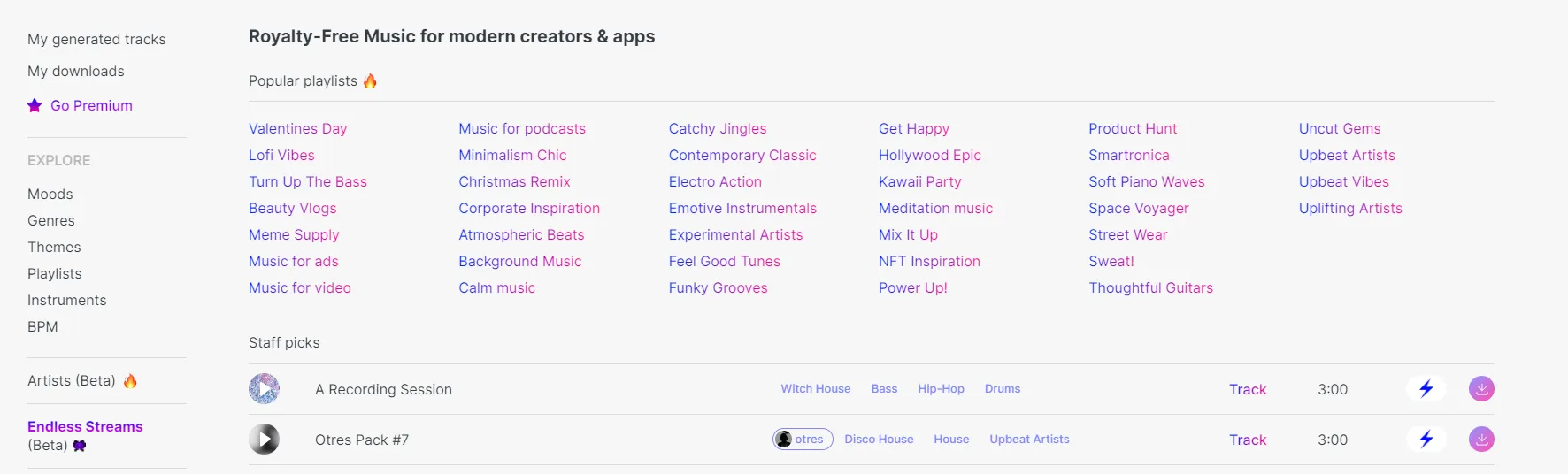
Explore is the other way in: a library of already-generated tracks you can filter by mood, genre, theme, playlist, instrument or BPM. If you are used to working with a sample library like Splice or Pond5, this will feel closer to that than to a generator.
Can you use Mubert commercially?
Only from the Pro plan up. This is where Mubert differs from most of its competitors, and it is worth being precise about, because two of the four plans cost money and still do not allow it.
- Ambassador (free) — personal, non-commercial use, with attribution.
- Creator — paid, and still personal and social-media use with no monetization. Promoted posts are allowed; monetized channels are not.
- Pro — the first plan that covers commercial use: monetized channels and digital ads. Client work, agency work and music in apps or games are not included.
- Ultra — adds client and freelance work, agency work, music in finished apps and games, and sub-licensing.
Two consequences are easy to miss. The first is that “royalty-free” and “you can monetize it” are not the same claim, and Mubert’s cheaper plans separate them. The second is that cancelling ends your use of the tracks in anything new, whichever plan you were on. Work you had already published can stay up under the licence it had, which on Creator never included earning from it.
That second point is where Mubert loses to Soundraw, whose help pages say you can keep monetizing songs you downloaded while subscribed.
How much does Mubert cost?
| Plan | Price | What you get |
|---|---|---|
| Ambassador | Free | 25 generations and 5 MP3 downloads a month. Personal, non-commercial use only, with credit to Mubert |
| Creator | $11.67/month | Billed yearly ($14 monthly). 100 generations and 50 downloads a month, WAV and MP3. Non-commercial on the pricing page |
| Pro | $32.49/month | Billed yearly ($39 monthly). 500 generations a month, unlimited downloads. The first plan that allows commercial use, monetized channels and digital ads |
| Ultra | $62.50/month | Billed yearly ($89 monthly). 1,000 generations a month, unlimited downloads; adds client work and music in apps and games |
Prices checked November 2026. Check current prices before you buy.
The figures above are the per-month rates when you pay for a year. Mubert charges more month to month: $14 for Creator, $39 for Pro and $89 for Ultra, as of November 2026.
Which plan should you pay for?
- Making videos, podcasts or ads you earn from, as a one-person operation: Pro, at $32.49 per month when billed yearly. It is the cheapest plan that lets you do it at all.
- Personal projects, or testing whether AI music suits your workflow: the free Ambassador plan, then Creator if 25 generations a month is not enough. Do not pay for Creator expecting to use the output commercially.
- Client or agency work, or music inside an app or game: Ultra, at $62.50 per month when billed yearly.
- One project, once: look at Mubert’s single-track licenses instead of a subscription. They are priced separately by use, from social content up to sublicensing, and the subscription table does not show them. Check the current rates on Mubert’s pricing page — the ones in our 2024 review are out of date and we have removed them rather than quote stale numbers.
What it is like to use
Our hands-on notes here are from the original 2024 review, which is why this piece is still marked as from the archive. The interface was clean and quick to learn, closer in feel to a sample library than to a DAW, and the prompt-to-track flow took four steps: write, set a duration, generate, download.
The honest observation from that test, and the one worth keeping: you will probably generate several tracks before you get one you want. That is normal for this category, but it changes how you should read the generation caps. On Creator’s 100 a month it matters less. On the free plan’s 25 generations and 5 downloads, it matters a great deal.
We have not run a current test of the output, so this review does not make a claim about how Mubert sounds in 2026.
Is Mubert worth it?
It depends, and mostly on one question: do you need to monetize what you make?
If you do, Mubert is a reasonable tool at an unreasonable entry point. Pro is the only plan that works for you, and about $390 a year is a real commitment for background music — more than some competitors charge for a license that also survives cancellation.
If you do not, the free plan is genuinely useful and the Creator plan is fairly priced for personal and social work, as long as you understand that leaving takes your library with you.
What Mubert does well is speed and breadth: a very large sample library, a prompt box, and a track in seconds. What it does badly is make its own licensing legible. The plan names suggest a ladder of capability, when the real step is a legal one between Creator and Pro, and nothing in the pricing table says so.
We would rather tell you that than let you find out after you have paid.
See Mubert’s current plans and license terms
Limitations
- The cheapest paid plan cannot be monetized. Creator costs $11.67 a month billed yearly (as of November 2026) and is still personal, non-commercial use, so Pro at $32.49 a month is the first plan a working creator can use. That is the single most expensive thing to get wrong here.
- Cancelling ends your right to use Mubert tracks in anything new, on every plan. Only work you had already published can stay up, under the licence it was published with, so tracks you downloaded but never used are gone.
- Even Pro stops short of client work, agency work and music in apps or games. Those need Ultra, at $62.50 a month billed yearly or $89 month to month (as of November 2026), which makes Mubert an expensive choice for freelancers.
- Mubert closed its affiliate program in 2026, and single-track licenses are sold separately from the subscriptions, so the real cost of a one-off project is not visible from the plan table alone.